
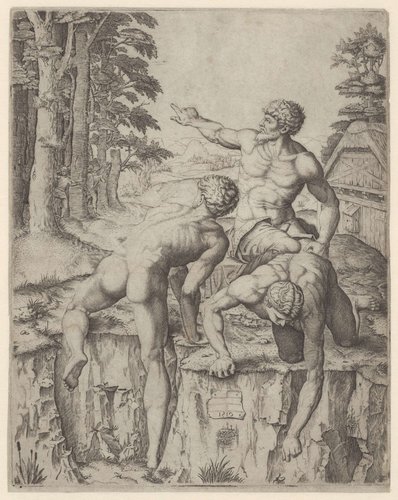
Drie naakte mannen in landschap
Medium
engraving
Dimensions
225; 284
Rights
Public Domain
About this artwork
date: ‘1510’
Art Historical Context
**Drie naakte mannen landschap (Three Naked Men in a Landscape)** *Marcantonio Raimondi, 1510, Engraving, 284 × 225 mm* Step into the High Renaissance with Marcantonio Raimondi’s *Drie naakte mannen in landschap*, a striking engraving from 1510 that captures three nude male figures poised dramatically within a sprawling natural setting. Raimondi, a master engraver active in early 16th-century Rome (c. 1480–1534), was renowned for translating the grand visions of painters like Raphael and Michelangelo into print. This work exemplifies his skill during his formative years, when he honed techniques that made intricate designs accessible beyond elite patrons. Engraving, Raimondi’s chosen medium, involved incising fine lines into a copper plate with a burin tool, then inking and pressing it onto paper—a labor-intensive process that allowed for exceptional detail and tonal depth. At 284 × 225 mm, this plate size was ideal for dissemination, revolutionizing art by enabling widespread sharing of Renaissance ideals of human anatomy and harmony with nature. The nude figures evoke classical antiquity, a hallmark of the era’s revival of Greco-Roman forms, blending idealized bodies with a serene landscape to celebrate beauty and proportion. Raimondi’s engravings bridged painting and printmaking, influencing generations and democratizing High Renaissance art. Imagine this piece circulating through workshops and collections, sparking admiration for its precision—truly a window into 1510’s artistic fervor. (198 words)
About the Artist
Marcantonio Raimondi · 1475–1534
Marcantonio Raimondi (c. 1480–1534), born near Bologna, Italy, emerged as one of the Renaissance's premier engravers, revolutionizing printmaking through his mastery of reproductive techniques. He trained in the workshop of the goldsmith, painter, and niellist Francesco Francia, whose influence is evident in his early engravings, such as the goldsmith-like shading in *Pyramus and Thisbe* (1505), h...