
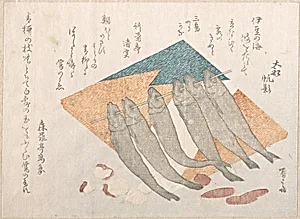
Dried Sardines, Tablet of Sea-Weed and Nuts
19th century
Medium
Woodblock print (surimono); ink and color on paper
Dimensions
5 3/16 x 7 1/16 in. (13.2 x 17.9 cm)
Classification
Prints
Culture & Period
Japan · Edo period (1615–1868)
Department
Asian Art
Museum
Metropolitan Museum of Art, New York, NY
Credit
H. O. Havemeyer Collection, Bequest of Mrs. H. O. Havemeyer, 1929
Accession Number
JP2159
Rights
Public Domain
Tags
Art Historical Context
In the vibrant world of Edo-period Japan (1615–1868), Ryūryūkyo Shinsai crafted this charming woodblock print titled *Dried Sardines Tablet of Sea-Weed Nuts* during the early 19th century. A master of surimono—luxurious, privately commissioned prints often exchanged as New Year's greetings or poetic tokens—this intimate work (just 5 3/16 x 7 1/16 inches) exemplifies the refined artistry of ukiyo-e, the "pictures of the floating world" that captured everyday beauty with exquisite detail. Shinsai's composition showcases a still life of dried sardines, a compressed tablet of seaweed, and scattered nuts, rendered in vivid inks and colors on paper. These humble yet symbolic foods evoke seasonal abundance and festivity, common motifs in surimono that delighted elite patrons. The woodblock technique allowed for precise layering of colors, subtle gradients, and sometimes metallic accents (though not specified here), highlighting Shinsai's skill in transforming ordinary subjects into poetic elegance. Housed in the Metropolitan Museum of Art's Asian Art Department from the prestigious H. O. Havemeyer Collection, this print offers a window into Japan's printmaking golden age, where art bridged poetry, nature, and celebration. Visitors, pause to savor its quiet harmony— a tasty reminder of Edo Japan's cultured whimsy!
About the Artist
Ryūryūkyo Shinsai · 1799–1823
Ryūryūkyo Shinsai (柳々居辰斎), active from 1799 to 1823, was a prominent Japanese ukiyo-e printmaker based in Edo (modern Tokyo), renowned for his mastery of surimono—luxurious, privately commissioned woodblock prints produced for elite poetry circles and New Year's celebrations. He began his training under Tawaraya Sōri before becoming a student of the legendary Katsushika Hokusai, from whom he recei...