
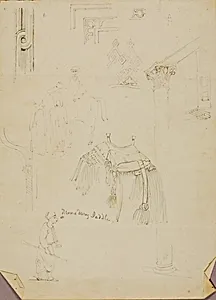
Dromedary Saddle/Studies
Medium
Drawing
Classification
Drawing
Department
Smithsonian Collection
Museum
Smithsonian American Art Museum
Credit
Smithsonian American Art Museum, Bequest of Martha F. Butler
Accession Number
1991.56.74
Rights
Public Domain
Tags
Art Historical Context
Miner Kilbourne Kellogg (1814–1889), a 19th-century American artist for his neoclassical portraits evocative landscapes, created *Dromedary Saddle/*, a set of preparatory drawings that capture the exotic allure of Middle Eastern motifs. Rendered in an undated drawing medium, these sketches feature detailed studies of a dromedaryone-humped camel) saddle, alongside equestrian elements like a horse, a male figure, and architectural columns. Kellogg's precise line work highlights anatomical forms and functional designs, reflecting the artist's keen observation during his extensive travels to Egypt and Syria in the mid-1800s. These studies embody the Orientalist fascination of the era, where Western artists romanticized Eastern cultures amid growing global exploration. As part of the Smithsonian American Art Museum's collection—bequeathed by Martha F. Butler—they offer insight into Kellogg's preparatory process, blending realism with a sense of adventure. Drawings like these were essential tools for artists, allowing quick capture of fleeting subjects to inform larger paintings, and they reveal the cultural exchange between America and the Islamic world. Today, *Dromedary Saddle/Studies* invites visitors to ponder 19th-century wanderlust, showcasing how everyday objects like a camel saddle could symbolize vast deserts and ancient trade routes. A testament to Kellogg's versatility, it bridges utilitarian craft with artistic inquiry.