
Droom
c. 1525 - c. 1562
Medium
engraving
Dimensions
296; 439
Rights
Public Domain
About this artwork
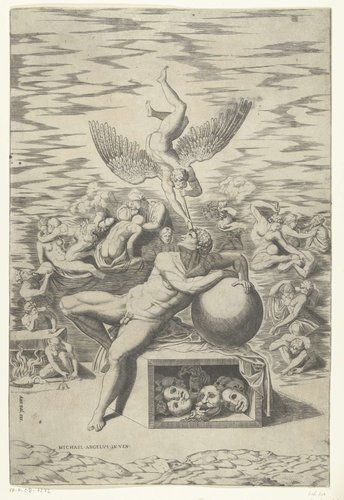
Een naakte jonge man zit op een stenen kubus en leunt op een wereldbol. In de kubus liggen maskers. Op de achtergrond zijn de zondige dromen van de jonge man verbeeldt. In sommige scènes worden hoofdzonden zoals wellust en gierigheid uitgebeeld. Vanuit de hemel blaast een engel met een bazuin in zijn oor en roept hem tot de orde.
Art Historical Context
Nicolas Beatrizet’s engraving *Droom* (c. 1525–1562) presents a vivid moral allegory in the refined linear style characteristic of 16th-century reproductive printmaking. A nude youth perches on a stone cube—masks spilling from its hollow—while resting against a terrestrial globe. Behind him unfold chaotic vignettes of his wayward dreams, including scenes of lust and avarice, until a heavenly angel sounds a trumpet to recall him to virtue. Beatrizet, active in Rome and closely associated with the circle of Michelangelo, specialized in translating painted compositions into widely circulated engravings. The work’s measured proportions (439 × 296 mm) and crisp burin work allow every symbolic detail to register clearly, inviting viewers to trace the progression from temptation to awakening. The cube and masks evoke fleeting worldly identities, while the globe underscores the youth’s entanglement with earthly desires. Such imagery resonated in Counter-Reformation Europe, where prints served both as private devotional aids and as accessible sermons on the dangers of unchecked fantasy. By combining classical figure types with contemporary moral concerns, *Droom* exemplifies how engravings extended the reach of Renaissance allegory beyond palace walls, offering museum visitors a window into the period’s blend of artistic elegance and ethical instruction.
About the Artist
Nicolas Beatrizet · 1515–1566
Nicolas Beatrizet, born around 1515 in Lunéville, Lorraine (then part of the Holy Roman Empire), emerged as one of the most prolific French engravers of the 16th century. Little is known about his early life and training, with no records of specific teachers or apprenticeships, though regional influences from German and Italian printmaking likely shaped his skills before he arrived in Rome around ...