
Drop-leaf Table
c. 1938
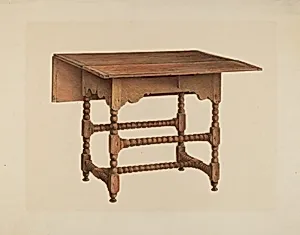
Medium
watercolor, colored pencil, and graphite on paperboard
Dimensions
overall: 32.2 x 40.3 cm (12 11/16 x 15 7/8 in.) Original IAD Object: none given
Classification
Index of American Design
Department
CG-W
Museum
National Gallery of Art, Washington, D.C.
Credit
Index of American Design
Accession Number
1943.8.5574
Rights
Public Domain
Art Historical Context
This delicate rendering of a drop-leaf table was created around 1938 by Isadore Goldberg as part of the Index of American Design, a New Deal initiative under the Works Progress Administration. The project employed hundreds of artists to produce precise watercolor and graphite illustrations documenting American decorative arts from the colonial era through the nineteenth century. Goldberg’s work captures the functional elegance of this adaptable furniture form, whose hinged leaves allowed it to expand for dining or contract for smaller spaces in early American homes. Executed in watercolor, colored pencil, and graphite on paperboard, the drawing exemplifies the Index’s emphasis on technical accuracy combined with artistic sensitivity. Such mixed-media techniques enabled artists to convey subtle wood grains, shadows, and construction details that photographs of the time could not fully achieve. Today, these works serve as both historical records and fine examples of American realism, preserving the craftsmanship of everyday objects for future generations. Housed in the National Gallery of Art’s collection, Goldberg’s illustration highlights the cultural value placed on documenting national design heritage during the Great Depression. It invites viewers to appreciate both the ingenuity of traditional furniture makers and the careful artistry of the Index illustrators themselves.
About the Artist
Isadore Goldberg · 1904–1995
Isadore Goldberg (b. 1904), an American artist, gained recognition through his contributions to the Index of American Design, a New Deal-era initiative under the Works Progress Administration's Federal Art Project. Active primarily in the late 1930s and early 1940s, Goldberg produced meticulous renderings of everyday American objects, capturing the essence of folk craftsmanship during a time when ...