
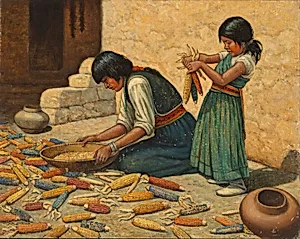
Drying Corn
ca. 1937-1943
Medium
Painting
Classification
Painting
Department
Smithsonian Collection
Museum
Smithsonian American Art Museum
Credit
Smithsonian American Art Museum, Gift of Mrs. Florence O.R. Lang
Accession Number
1985.66.383,336
Rights
Public Domain
Tags
Art Historical Context
**Drying Corn** by Carl Moon (ca. 1937–1943) captures a tender moment in Native American daily life, depicting a woman and child in traditional Indian dress as they tend to corn, likely preparing it for cooking or storage. This oil painting, now in the Smithsonian American Art Museum, reflects Moon's lifelong dedication to documenting Southwestern Indigenous cultures, particularly among the Hopi and other Pueblo peoples. As both a photographer and painter, Moon brought an ethnographic eye to his work, blending realism with reverence for his subjects. Created during the late 1930s and early 1940s—a time of economic hardship and cultural shifts in America—the artwork highlights the enduring significance of corn in Native traditions. Corn, a sacred staple, symbolizes sustenance, community, and resilience, with drying techniques preserving it through harsh seasons. Moon's realistic style, honed from decades of fieldwork, invites viewers to appreciate these rituals amid modernization pressures. This piece, gifted by Mrs. Florence O.R. Lang, underscores the Smithsonian's commitment to preserving stories of Indigenous heritage, offering museum visitors a window into a vital cultural practice that continues to resonate today.