
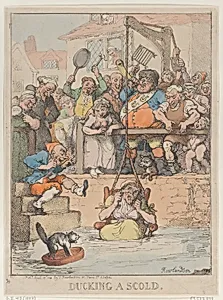
Ducking a Scold
[April 12, 1803], reissued April 12, 1812
Medium
Hand-colored etching
Dimensions
Sheet: 12 13/16 × 9 7/16 in. (32.5 × 23.9 cm)
Classification
Prints
Department
Drawings and Prints
Museum
Metropolitan Museum of Art, New York, NY
Credit
The Elisha Whittelsey Collection, The Elisha Whittelsey Fund, 1959
Accession Number
59.533.899
Rights
Public Domain
Tags
Art Historical Context
Thomas Rowlandson's *Ducking a Scold* (1803, reissued 1812) is a vibrant hand-colored etching that captures the sharp wit of early 19th-century British. Measuring about 13 by 9 inches, this print exemplifies Rowlandson's mastery of caricature, a style he helped popularize alongside contemporaries like James Gillray. As a leading figure in London's printmaking scene, Rowlandson delighted audiences with humorous, often bawdy depictions of social follies, using exaggerated figures and lively scenes to poke fun at human vices. The title refers to the archaic "ducking stool" punishment, where nagging or quarrelsome women—known as "scolds"—were dunked in water to curb their tongues. Here, Rowlandson satirizes gender tensions and outdated customs, featuring men, women, and even cats in a chaotic tableau of comeuppance and comedy. The hand-coloring technique, applied by skilled artisans post-etching, adds vivid hues that heighten the print's theatrical energy, making it a bestseller in its day. Housed in the Metropolitan Museum of Art's Drawings and Prints department, this work highlights the cultural role of satire in Regency-era Britain, critiquing domestic life while entertaining the masses. It's a window into a time when prints like this shaped public discourse, blending cruelty with levity in a single, unforgettable image.
About the Artist
Thomas Rowlandson · 1756–1827
Thomas Rowlandson (1757–1827) was an English artist and caricaturist whose satirical watercolors and prints captured the social life of Georgian Britain with unparalleled wit and technical mastery. Alongside James Gillray, he is recognized as one of the greatest British graphic artists, and his distinctive flowing line and keen observations have made his work integral to understanding late 18th an...