
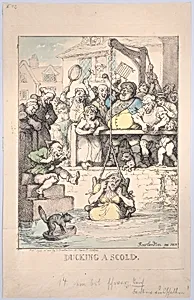
Ducking a Scold
April 12, 1803
Medium
Hand-colored etching
Dimensions
Plate: 13 3/4 × 9 3/4 in. (35 × 24.8 cm) Sheet: 16 5/8 × 10 9/16 in. (42.3 × 26.8 cm)
Classification
Prints
Department
Drawings and Prints
Museum
Metropolitan Museum of Art, New York, NY
Credit
The Elisha Whittelsey Collection, The Elisha Whittelsey Fund, 1959
Accession Number
59.533.1963
Rights
Public Domain
Tags
Art Historical Context
Thomas Rowlandson's *Ducking a Scold* (April 12, 1803) is a vibrant hand-colored etching that captures the cheeky spirit of Georgian-era satire. Measuring about 13¾ × 9¾ inches on the plate, this print the Metropolitan Museum of Art's Drawings and Prints department exemplifies Rowlandson's mastery of caricature. Known for his humorous, often bawdy depictions of British society, Rowlandson employed, expressive lines and vivid hand-color—a popular technique in early19th-century printmaking—to make his works both affordable and visually appealing to a wide audience. The title refers to the "ducking stool," a real historical punishment in England for "scolds"—typically accused of nagging or gossiping—who were strapped to a chair and dunked in water or sewage. Rowlandson's scene satirizes this gender-infused custom, featuring men, women, and cats in a chaotic, comedic tableau that pokes fun at social norms, domestic strife, and public spectacles. Cats, recurring in his prints, likely add a layer of mischievous whimsy, symbolizing sly household disruptions. As part of The Elisha Whittelsey Collection, this etching highlights Rowlandson's role in the golden age of British caricature, bridging artists like Hogarth and Cruikshank. It invites us to chuckle at outdated justice while reflecting on enduring themes of power and pettiness in everyday life.
About the Artist
Thomas Rowlandson · 1756–1827
Thomas Rowlandson (1757–1827) was an English artist and caricaturist whose satirical watercolors and prints captured the social life of Georgian Britain with unparalleled wit and technical mastery. Alongside James Gillray, he is recognized as one of the greatest British graphic artists, and his distinctive flowing line and keen observations have made his work integral to understanding late 18th an...