
Medium
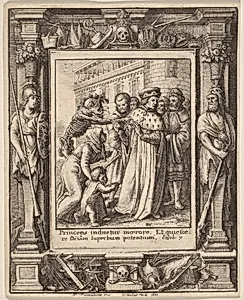
etching with border "Minerva and Hercules" (Pennington 233B)
Classification
Department
CG-E
Museum
National Gallery of Art, Washington, D.C.
Credit
Rosenwald Collection
Accession Number
1943.3.4884
Rights
Public Domain
Art Historical Context
This etching titled *Duke*, created in1651 by Wenceslaus Hollar, represents a fascinating chain of artistic transmission across centuries. Hollar, a prolific Bohemian-born printmaker active in England, based his work on a design by Hans Holbein the Younger, the celebrated German Renaissance painter known for his penetrating portraits at the Tudor court. Holbein’s composition was itself filtered through the Flemish artist Abraham van Diepenbeeck, resulting in a layered reproduction that brought earlier imagery to new audiences. Executed in etching with an elaborate border featuring Minerva and Hercules, the print exemplifies the 17th-century practice of disseminating important designs through affordable multiples. Etching allowed Hollar to capture fine details and textures with remarkable precision, preserving the dignity and presence of the original portrait while adding his own refined line work. Such prints played a vital role in spreading knowledge of Renaissance masters beyond royal collections and private patrons. Now part of the National Gallery of Art’s Rosenwald Collection, this work highlights the enduring appeal of Holbein’s portraits and the skill of reproductive printmakers in shaping art history.