
Medium
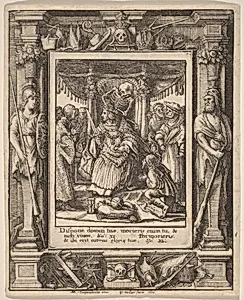
etching with border "Minerva and Hercules" (Pennington 233B)
Classification
Department
CG-E
Museum
National Gallery of Art, Washington, D.C.
Credit
Rosenwald Collection
Accession Number
1943.3.4880
Rights
Public Domain
Art Historical Context
Step into the intricate world of 17th-century printmaking with *Emperor*, a masterful etching created by Wenceslaus Hol in 1651. Hollar, a Bohemian renowned for his exquisite reproductive prints, drew from designs by two giants: Hans Holbein the, the Tudor-era portraitist famous for his precise, psychological depth, and Abraham van Diebeeck, a Flemish painter. This layered attribution highlights the collaborative spirit of the era, where etchings preserved and disseminated prestigious images across Europe. The work's medium—etching with an elaborate border depicting Minerva (goddess of wisdom) and Hercules (emblem of strength)—elevates a stately portrait of an emperor into a symbolic tableau. Etching allowed Hollar to capture fine lines and textures with remarkable fidelity, making high art accessible beyond original paintings. Housed in the National Gallery of Art's Rosenwald Collection (Pennington 233B), it exemplifies how prints bridged Renaissance precision and Baroque grandeur, influencing collectors and artists alike. This piece invites reflection on imperial power framed by classical virtues, a nod to the era's fascination with antiquity amid political upheavals like the English Civil War. A testament to Hollar's technical virtuosity, *Emperor* remains a captivating window into artistic lineage and cultural exchange.