
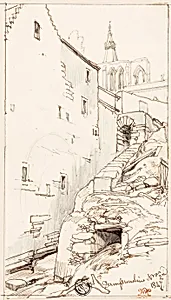
Dunfermline
March 2, 1847
Medium
Pen and brown ink and graphite on ivory wove paper, laid down on board
Dimensions
16.6 × 9.2 cm (6 9/16 × 3 5/8 in.)
Classification
pen and ink drawings
Department
Prints and Drawings
Museum
Art Institute of Chicago
Accession Number
95712
Rights
Public Domain
Art Historical Context
William Leighton Leitch's *Dunfermline*, dated March 2, 1847, captures the essence of Scotland's historic Fife region in a compact, intimate sketch. Leitch, a renowned Scottish draughtsman and watercolorist (1804–1883), was celebrated for his precise topographical views and served as drawing master to Queen Victoria. work, executed on ivory wove paper laid down on board, reflects the Victorian fascination with picturesque landscapes and national heritage, at a time when railways were opening up remote Scottish sites like Dunfermline Abbey—a royal burial ground for early Scottish kings. Measuring just 16.6 × 9.2 cm, the drawing exemplifies the portability of pen-and-ink sketches, ideal for artists traveling to document architecture and scenery en plein air. Leitch employs brown ink for fluid lines and graphite for subtle shading, creating depth and texture on the small scale. Housed in the Art Institute of Chicago's Prints and Drawings department, it highlights the medium's role in 19th-century artistic practice: quick studies that often informed larger paintings or served as collectible standalone pieces. This delicate gem invites visitors to appreciate Leitch's masterful observation, bridging everyday sketching with enduring cultural memory of Scotland's storied past.
About the Artist
William Leighton Leitch · 1804–1883
Comment on works: landscape