
Eagle
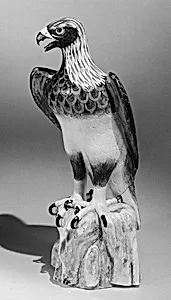
Medium
Hard-paste porcelain
Dimensions
Height: 22 1/2 in. (57.2 cm)
Classification
Ceramics-Porcelain
Culture
German, Meissen
Department
European Sculpture and Decorative Arts
Museum
Metropolitan Museum of Art, New York, NY
Credit
Gift of Mrs. Abby Rockefeller Mauzé, 1959
Accession Number
59.31.1
Rights
Public Domain
Tags
Art Historical Context
Perched with majestic intensity, this life-sized *Eagle* (ca. 1731) from the Meissen Manufactory exemplifies the pinnacle of early European porcelain artistry. Modeled by Johann Gottlieb Kirchner, a master sculptor renowned for his naturalistic animal figures, the 22½-inch (57.2 cm) hard-paste porcelain bird captures the raptor’s fierce gaze and powerful stance in exquisite detail. Produced in Meissen, Germany—the first European center to successfully manufacture true hard-paste porcelain since 1710—this piece reflects the technical wizardry of the era, rivaling the finest Chinese imports with its translucency, durability, and fine glaze. Meissen porcelain, patronized by Augustus the Strong, Elector of Saxony, marked a cultural triumph, transforming a once-mysterious Eastern luxury into a Baroque symbol of royal prestige. Kirchner’s eagle, with its dynamic modeling and intricate featherwork, showcases the manufactory’s innovative techniques, like meticulous mold-making and multi-stage firing to achieve lifelike textures. Eagles, emblems of imperial power and vigilance, held special resonance in 18th-century Europe, making this sculpture both a decorative marvel and a statement of artistic ambition. Today, housed in the Metropolitan Museum of Art as a gift from Mrs. Abby Rockefeller Mauzé (1959), it invites visitors to marvel at how fragile clay became an enduring icon of German ingenuity.
About the Artist
Meissen Manufactory|Johann Gottlieb Kirchner · 1710–present
The Meissen Manufactory, established on June 6, 1710, by Augustus the Strong, Elector of Saxony and King of Poland, marked the dawn of true hard-paste porcelain production in Europe. Nestled at Albrechtsburg Castle in Meissen near Dresden, the Royal Polish and Electoral Saxon Porcelain Manufactory arose from alchemical experiments begun in 1708 by physicist Ehrenfried Walther von Tschirnhaus and p...