
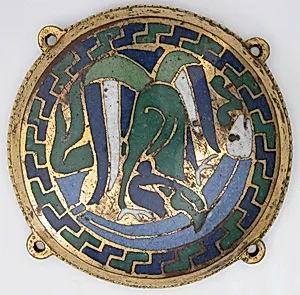
Eagle Attacking a Fish (one of five medallions from a coffret)
Unknown Artist
ca. 1110–30
Medium
Copper-gilt, champlevé enamel
Dimensions
Overall: 3 9/16 x 9/16 in. (9 x 1.5 cm) Overall (with nail tangs): 3 15/16 x 9/16 in. (10 x 1.5 cm)
Classification
Enamels-Champlevé
Culture
French
Department
Medieval Art
Museum
Metropolitan Museum of Art, New York, NY
Credit
Gift of J. Pierpont Morgan, 1917
Accession Number
17.190.689
Rights
Public Domain
Tags
Art Historical Context
Behold the dynamic "Eagle Attacking a Fish," one of five medallions adorning a luxurious coffret, or small casket, crafted in France around 1110–30. This tiny treasure, measuring just under 4 inches across, captures a moment of raw natural drama: a majestic eagle swoops down on its prey, embodying the medieval fascination with the wild kingdom. Produced during the Romanesque period, such enamels decorated high-status objects like reliquaries or jewelry boxes, blending artistry with piety and power. The masterpiece employs champlevé enamel on copper-gilt—a sophisticated technique where artisans carved troughs into the metal base, filled them with molten glass-like enamel in vivid colors, and fired it to fuse. This method, peaking in early 12th-century France, allowed for bold, durable designs that withstood time. The eagle's fierce talons and the fish's glistening scales highlight emerging naturalism in medieval art, moving beyond stiff symbolism toward lively observation. Housed in the Metropolitan Museum of Art thanks to J. Pierpont Morgan's 1917 gift, this medallion invites us to ponder medieval life's blend of beauty and brutality. Though the artist remains unknown, its survival speaks to the era's enamel mastery, a craft that turned humble metal into shimmering jewels of history.