
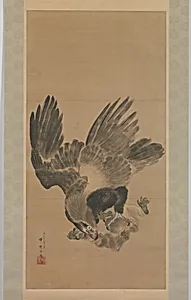
猿を襲う鷲図|Eagle Attacking a Monkey
Medium
Hanging scroll; ink and color on paper
Dimensions
Image: 65 1/2 × 32 7/8 in. (166.4 × 83.5 cm) Overall with mounting: 111 1/2 in. × 43 3/8 in. (283.2 × 110.2 cm) Overall with knobs: 111 1/2 in. × 47 3/4 in. (283.2 × 121.3 cm)
Classification
Paintings
Culture & Period
Japan · Meiji period (1868–1912)
Department
Asian Art
Museum
Metropolitan Museum of Art, New York, NY
Credit
Charles Stewart Smith Collection, Gift of Mrs. Charles Stewart Smith, Charles Stewart Smith Jr., and Howard Caswell Smith, in memory of Charles Stewart Smith, 1914
Accession Number
14.76.64a
Rights
Public Domain
Tags
Art Historical Context
In the turbulent Meiji period (1868–1912), when Japan rapidly modernized amid Western influences, Kawanabe Kyōsai (1831–1889) created *Eagle Attacking a* in 1885. As one of the last great of ukiyo-e and a pioneer of *kyōga* (mad poetry pictures), Kyōsai infused his works with bold satire, whimsy, and dynamic energy. This hanging scroll captures a tense moment in nature: a fierce eagle diving upon a hapless monkey, embodying the raw power struggles of the wild that often mirrored societal upheavals of the era. Rendered in vibrant ink and color on paper, the monumental image (65½ × 32⅞ in.) showcases Kyōsai's masterful brushwork—fluid lines evoking motion, subtle color washes heightening drama, and exaggerated forms typical of his grotesque yet playful style. Hanging scrolls like this were prized in Japanese homes and temples, unrolled for intimate viewing during gatherings, allowing the artwork's intensity to unfold vertically like a theatrical scroll. Housed in the Metropolitan Museum of Art's Asian Art collection, this piece from the Charles Stewart Smith Collection highlights Kyōsai's enduring legacy. It invites viewers to ponder the eagle's predatory strike as a metaphor for life's unpredictability, blending traditional Japanese artistry with the artist's irreverent spirit.
About the Artist
Kawanabe Kyōsai 河鍋暁斎 (Japanese) · 1831 –1889
Japanese, 1831–1889