
Eagle (one of a pair)
ca. 1730
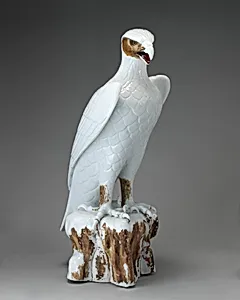
Medium
Hard-paste porcelain with cold-painted decoration
Dimensions
22 × 5 13/16 × 10 in. (55.9 × 14.7 × 25.4 cm)
Classification
Ceramics-Porcelain
Culture
German, Meissen after a Japanese model
Department
European Sculpture and Decorative Arts
Museum
Metropolitan Museum of Art, New York, NY
Credit
Bequest of Mrs. Charles Wrightsman, 2019
Accession Number
2019.283.52
Rights
Public Domain
Tags
Art Historical Context
Behold the majestic *Eagle (one of a pair)*, a stunning example of early 18th-century porcelain from the Meissen Manufactory, Germany's pioneering center for hard-paste porcelain 1730. Standing nearly two feet tall, this impressive bird—crafted after a Japanese model—captures the Rococo era's fascination with exotic Oriental influences, blending European technical prowess with Eastern aesthetics. Meissen revolutionized ceramics by developing hard-paste porcelain in 1710, a formula long guarded by Chinese and Japanese makers, allowing for delicate translucency and durability unmatched by soft-paste alternatives. Here, the eagle's form is meticulously modeled, then adorned with cold-painted enamels—vibrant colors applied after firing for a lifelike sheen, though more prone to wear than fired glazes. These pairs were prized display pieces in aristocratic homes, symbolizing imperial power through the eagle's commanding presence. Generously bequeathed to the Metropolitan Museum of Art in 2019, this work highlights Meissen's role in elevating porcelain from utilitarian ware to high art, bridging cultures and fueling Europe's "white gold" obsession. A testament to innovation and elegance!
About the Artist
Meissen Manufactory · 1710–present
The Meissen Manufactory, established on June 6, 1710, by Augustus the Strong, Elector of Saxony and King of Poland, marked the dawn of true hard-paste porcelain production in Europe. Nestled at Albrechtsburg Castle in Meissen near Dresden, the Royal Polish and Electoral Saxon Porcelain Manufactory arose from alchemical experiments begun in 1708 by physicist Ehrenfried Walther von Tschirnhaus and p...