
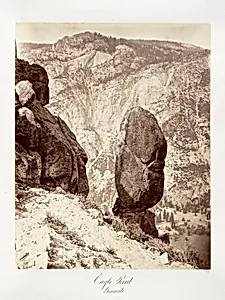
Eagle Point, Yosemite
ca. 1872, printed ca. 1876
Medium
Albumen silver print from glass negative
Classification
Photographs
Department
Photographs
Museum
Metropolitan Museum of Art, New York, NY
Credit
Gift of Carole and Irwin Lainoff, Ruth P. Lasser and Joseph R. Lasser, Mr. and Mrs. John T. Marvin, Martin E. and Joan Messinger, Richard L. Yett and Sheri and Paul Siegel, 1986
Accession Number
1986.1189.53
Rights
Public Domain
Tags
Art Historical Context
**Eagle Point,** (ca. 1872, printed ca. 1876) by Carleton E. Watkins captures the majestic drama of Yosemite Valley's towering granite cliffs and expansive vistas. Watkins, a pioneering American photographer, hauled massive cameras and glass plates into remote wilderness to document the Sierra Nevada's sublime landscapes. This albumen silver print from a glass negative showcases Eagle Point's rugged form, evoking the awe-inspiring scale that defined Yosemite's natural wonders. In the 19th century, Watkins's photographs played a pivotal role in conservation efforts. His stunning images of Yosemite, shared in exhibitions and publications, influenced President Lincoln's signing of the Yosemite Grant in 1864—the nation's first instance of wilderness preservation—and later the park's establishment in 1890. By framing untamed beauty with precise composition, Watkins elevated photography as an art form, bridging Romanticism's reverence for nature with emerging documentary realism. The albumen process, using egg whites to bind light-sensitive silver salts, produced prints with exceptional tonal depth and detail, ideal for Watkins's large-format "mammoth plates." Printed years after exposure, this work at the Metropolitan Museum of Art highlights photography's power to preserve fleeting wilderness moments for generations of visitors.
About the Artist
Carleton E. Watkins · 1829–1916
Carleton E. Watkins (1829–1916), one of America's pioneering landscape photographers, was born on November 11, 1829, in Oneonta, New York, the eldest of eight children to carpenter John Watkins and innkeeper Julia. Drawn by the Gold Rush, he arrived in San Francisco in 1851 at age 22 alongside childhood friend Collis Huntington, who later became a railroad tycoon. Initially working as a carpenter ...