
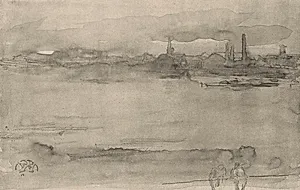
Early Morning
Medium
Lithotint with scraping, on a prepared half-tint ground, in black on cream wove proofing paper
Dimensions
Image: 16.5 × 26.9 cm (6 1/2 × 10 5/8 in.); Sheet: 25.6 × 37.9 cm (10 1/8 × 14 15/16 in.)
Classification
lithotint
Department
Prints and Drawings
Museum
Art Institute of Chicago
Accession Number
139397
Rights
Public Domain
About this artwork
Whistler experimented with the expressive potential of lithography, and in the case of his rare lithotints, he applied washes of ink directly to the stone to create veils of pigment. The result is a nuanced representation of light and fog, as is seen in these evocations of life on London’s Thames River. At the time he produced these prints, Whistler was involved in a lawsuit with the famed English art critic John Ruskin, who had argued that the abstraction of one of Whistler’s painted Nocturnes ...
Art Historical Context
James McNeill Whistler’s *Early Morning* (1878) is a masterful example of his innovative printmaking, housed in the Art Institute of Chicago’s Prints and Drawings. Created as a lithotint with scraping on a prepared half-tint ground in black ink on cream wove proof paper, this intimate work measures just 16.5 × 26.9 cm for the image, inviting close contemplation of its delicate textures. Whistler, the American-born artist renowned for his Aestheticism and tonal harmonies, used lithography to evoke subtle atmospheres akin to his famous oil nocturnes. Lithotint, a technique Whistler helped popularize in the 1870s, allowed for painterly effects through fluid tusche drawing on stone, followed by scraping to reveal highlights against a mid-tone ground. This method produced soft gradations and ethereal light, bridging painting and printmaking during a period when Whistler experimented boldly after his Venice etchings. *Early Morning* exemplifies his pursuit of "art for art’s sake," prioritizing mood over narrative. As a proof on wove paper, it reflects the experimental nature of 19th-century print production, offering visitors a window into Whistler’s technical genius and the era’s fascination with tonal subtlety. A gem for print enthusiasts!
About the Artist
James McNeill Whistler · 1834–1903
James Abbott McNeill Whistler (1834-1903) was an American-born painter and printmaker who became a leading figure in the Aesthetic Movement and pioneer of Tonalism and Japonisme. He revolutionized art by championing "art for art's sake" and treating paintings as visual equivalents of musical compositions, titling works as "arrangements," "harmonies," and "nocturnes" to emphasize formal qualities o...