
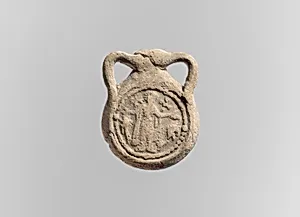
Earthenware Pilgrim Flask with Saint Menas
Unknown Artist
ca. 610–50
Medium
Earthenware
Dimensions
Overall: 3 3/8 x 2 11/16 x 11/16 in. (8.5 x 6.9 x 1.8 cm)
Classification
Ceramics
Culture
Byzantine
Department
Medieval Art
Museum
Metropolitan Museum of Art, New York, NY
Credit
Gift of J. Pierpont Morgan, 1917
Accession Number
17.194.2291
Rights
Public Domain
Tags
Art Historical Context
This delicate earthenware pilgrim flask crafted around 610–650 in Byzantine Egypt, exemplifies the portable piety of early medieval pilgrims. Measuring just 3⅜ x 2¹¹⁄₁₆ x ¹¹⁄₁₆ inches, it was designed to hold holy water or oil from sacred sites, allowing devotees to carry blessings on their journeys. Produced at the renowned pilgrimage center of Abu Mena near Alexandria, these flasks were mass-made using molds, making religious devotion accessible to ordinary travelers. The flask features a molded image of Saint Menas, a 3rd-century Egyptian soldier-saint and protector of caravans, often depicted with camels symbolizing his miracles. As a key figure in Byzantine Christianity, Menas embodied faith amid the empire's turbulent transitions from paganism and into Islamic rule. This artifact highlights the fusion of utilitarian ceramics with devotional art, showcasing simple yet effective relief techniques on fired earthenware. Housed in the Metropolitan Museum of Art's Medieval Art department through a 1917 gift from J. Pierpont Morgan, this flask offers a tangible link to vibrant pilgrimage traditions, revealing how everyday objects became vessels of spiritual power in the early Byzantine world.