
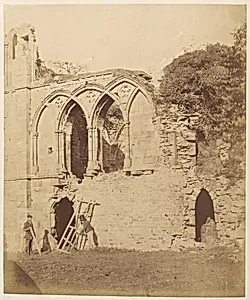
Easby Abbey. The Refectory
Medium
Albumen silver print
Dimensions
Image: 28 x 23.5 cm (11 x 9 1/4 in.) Mount: 43.9 x 30 cm (17 5/16 x 11 13/16 in.)
Classification
Photographs
Department
Photographs
Museum
Metropolitan Museum of Art, New York, NY
Credit
David Hunter McAlpin Fund, 1952
Accession Number
52.640 (12)
Rights
Public Domain
Tags
Art Historical Context
Step into the haunting beauty of *Easby Abbey. The Refectory*, a captivating albumen silver print from the1850s by photographers Joseph Cundall and Henry Delamotte. image (28 x 23.5 cm) elegantly captures the crumbling refectory—the communal dining hall—of Easby Abbey, a medieval Premonstratensian in North Yorkshire, England. Founded in the 12th century and dissolved during Henry VIII's Reformation in the 1530s, the abbey's ruins embody the Romantic fascination with decayed grandeur, evoking a sense of lost monastic life amid ivy-cloaked arches and weathered stone. Cundall and Delamotte, pioneers in early British photography, documented such architectural treasures during the medium's nascent years. Albumen silver prints, made by coating paper with egg whites and sensitizing it with silver salts, produced richly toned, detailed images from glass negatives—revolutionizing how history was preserved. This technique's crisp clarity highlights the abbey's intricate Gothic details, making the photograph both a precise record and an artistic evocation of time's passage. Displayed at The Metropolitan Museum of Art (acquired via the David Hunter McAlpin Fund in 1952), this work bridges photography's technical birth with cultural heritage, inviting visitors to ponder the echoes of medieval devotion in a single, luminous frame.