
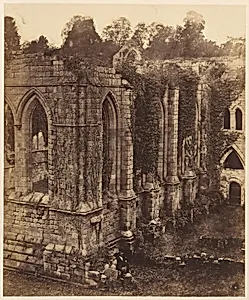
Fountains Abbey. The Refectory and Kitchen
Medium
Albumen silver print
Dimensions
Image: 28.5 x 23.6 cm (11 1/4 x 9 5/16 in.) Mount: 43.9 x 30 cm (17 5/16 x 11 13/16 in.)
Classification
Photographs
Department
Photographs
Museum
Metropolitan Museum of Art, New York, NY
Credit
David Hunter McAlpin Fund, 1952
Accession Number
52.640 (4)
Rights
Public Domain
Tags
Art Historical Context
Step into the evocative ruins of Fountains Abbey through this stunning 1850s albumen silver print by Joseph Cundall and Philip Henry Delamotte.uring the Refectory and Kitchen—once bustling heart of this grand Cistercian monastery in Yorkshire, England—the image measures 28.5 x 23.6 cm and preserves the abbey’s weathered stone arches and vaults with remarkable clarity. Founded in 1132 and dramatically dissolved during Henry VIII’s Reformation in 1539, Fountains Abbey stands as one of Britain’s largest and most intact monastic ruins, symbolizing medieval monastic life and its turbulent end. Cundall and Delamotte, pioneers in early photography, documented such architectural treasures amid the Victorian fascination with Gothic ruins and romantic nationalism. Their collaborative work helped preserve these sites visually for a growing audience, blending artistry with emerging science. The albumen process, using egg whites to coat paper with light-sensitive silver salts, yielded richly toned, finely detailed prints that captured intricate textures—from crumbling masonry to lingering shadows—making this medium a cornerstone of 19th-century photography. Today, housed in The Metropolitan Museum of Art thanks to the David Hunter McAlpin Fund (1952), this photograph invites us to ponder the abbey’s echoes of prayer, communal meals, and time’s gentle decay, bridging history and innovation in a single frame.