
Ecce Homo
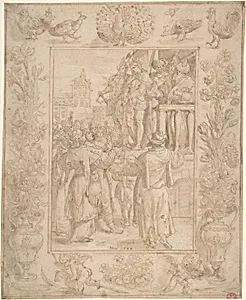
Medium
Pen and brown ink, brush and brown and gray wash; incised for transfer; framing lines in pen and brown ink
Dimensions
sheet: 2 7/8 x 2 3/16 in. (7.3 x 5.6 cm)
Classification
Drawings
Department
Drawings and Prints
Museum
Metropolitan Museum of Art, New York, NY
Credit
Edward Pearce Casey Fund, 2002
Accession Number
2002.120
Rights
Public Domain
Tags
Art Historical Context
Behold the intricate "Ecce Homo" (1584), a collaborative drawing by Flemish artists Maerten de Vos and Bol, now housed in the Metropolitan Museum of Art's Drawings and Prints department.ed in pen and brown ink with brush and brown and gray, this diminutive sheet—measuring just 2 7/8 x 2 3/16 inches—was incised for transfer, technique used to replicate the design onto another surface, likely for engraving or printmaking. Framing lines in pen and brown add a polished boundary, underscoring its preparatory role in the bustling Antwerp workshops of the late Northern Renaissance. The composition centers on the biblical "Ecce Homo" theme—Pilate's presentation of Christ—infused with vivid symbolic details: peacocks evoking resurrection and immortality, vigilant roosters, ethereal angels, and blooming flowers. De Vos, a leading Mannerist painter of religious scenes, likely led the figurative elements, while Bol, renowned for landscapes and nature studies, contributed the flora and fauna. This blend reflects the era's Mannerist style, with its elegant lines and layered symbolism, bridging devotion and artistry amid the Counter-Reformation's push for emotive imagery. As a rare survivor of workshop practice, this drawing highlights the collaborative ingenuity of 16th-century Flemish draftsmen, transforming a tiny sketch into a vehicle for widespread religious dissemination through prints. A testament to technical precision and spiritual depth, it invites visitors to ponder the divine amid nature's splendor.