
Portrait of Jan Hus
mid-16th–early 17th century
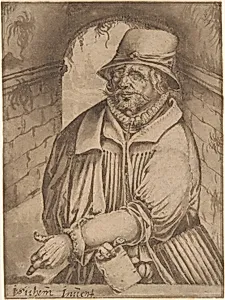
Medium
Pen and brown ink, brown wash, incised for transfer
Dimensions
sheet: 6 1/2 x 4 3/4 in. (16.5 x 12.1 cm)
Classification
Drawings
Department
Drawings and Prints
Museum
Metropolitan Museum of Art, New York, NY
Credit
Harry G. Sperling Fund, 2007
Accession Number
2007.140
Rights
Public Domain
Tags
Art Historical Context
This delicate portrait captures Jan Hus, the 15th-century Czech theologian and reformer whose ideas helped inspire the Protestant Reformation. Executed in pen and brown ink with subtle brown wash, the drawing shows Hus in scholarly attire, his thoughtful expression conveying both intellect and quiet resolve. Though Hus lived more than a century before this work was made, artists of the Reformation era frequently created such images to honor him as a martyr who was burned at the stake in 1415 for challenging Church authority. Created by Dutch printmaker Christoffel van Sichem I in the late 1500s or early 1600s, the sheet was incised for transfer, indicating it served as a preparatory design for an engraving. This practical technique allowed the image to be reproduced and widely circulated at a time when printed portraits of religious reformers played a vital role in spreading new ideas across Europe. Measuring just 6½ by 4¾ inches, the intimate scale suggests it was meant for personal devotion or study rather than public display. Housed in the Metropolitan Museum of Art’s Department of Drawings and Prints, this work highlights how drawings often formed the foundation for influential printed imagery. Van Sichem’s careful linework and restrained use of wash give the portrait a sense of immediacy, inviting viewers to connect with a figure whose courage continued to resonate long after his death.