
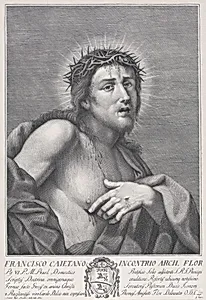
Ecce Homo
1765–1805
Medium
Etching and engraving
Dimensions
Sheet (Trimmed): 15 1/2 × 10 7/16 in. (39.4 × 26.5 cm)
Classification
Prints
Department
Drawings and Prints
Museum
Metropolitan Museum of Art, New York, NY
Credit
The Elisha Whittelsey Collection, The Elisha Whittelsey Fund, 1951
Accession Number
51.501.4208
Rights
Public Domain
Art Historical Context
Behold the poignant "Ecce Homo," a masterful etching and engraving after a painting by the 17th-century Florentine Baroque artist Carlo Dol, executed by engraver Gaetano Vascellini 1765 and 1805. The title, Latin for "Behold the Man," refers to biblical moment when Pontius Pilate presents the crowned Christ to the crowd, a dramatic motif central to Christian iconography. Dolci, renowned for his exquisitely refined religious works with luminous flesh tones and emotional intensity, captured Christ's suffering with tender realism, a style Vascellini faithfully reproduced in this print. Etching and engraving were pivotal techniques in 18th-century printmaking, allowing precise translation of paintings into affordable multiples. Vascellini's skilled combination—etching for fluid lines and engraving for sharp detail—preserved Dolci's intricate textures and expressive faces on a trimmed sheet measuring 15½ × 10⁷/₁₆ inches. This process democratized access to elite art, spreading Baroque devotional imagery across Europe. Housed in the Metropolitan Museum of Art's Drawings and Prints department as part of The Elisha Whittelsey Collection (acquired 1951), this print exemplifies how reproductive prints bridged centuries, sustaining Dolci's legacy amid the Enlightenment's artistic shifts. A testament to faith, technique, and cultural exchange, it invites visitors to ponder humanity's shared gaze on suffering and redemption.
About the Artist
Gaetano Vascellini|Carlo Dolci (Italian|Italian) · 1745 |1616 –1805 |1687
Italian, Castel San Giovanni 1745–1805 Florence|Italian, Florence 1616–1687 Florence