
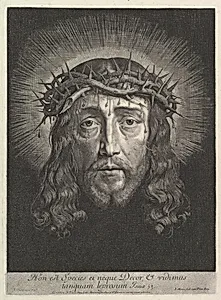
La sainte Face couronnee d'epines, (grand format)
Medium
Etching, second state
Dimensions
sheet: 20 x 13 3/4 in. (50.8 x 35 cm) image: 16 15/16 x 12 1/2 in. (43 x 31.8 cm)
Classification
Prints
Department
Drawings and Prints
Museum
Metropolitan Museum of Art, New York, NY
Credit
Harris Brisbane Dick Fund, 1945
Accession Number
45.41.53
Rights
Public Domain
Tags
Art Historical Context
In the hushed galleries of the Metropolitan Museum of Art's Drawings and Prints department, *La Sainte Face Couronnée d'Épines (Grand Format)* captivates with its poignant depiction of Christ's face crowned with thorns. Attributed to the collaboration of French engraver Jean and painter Philippe de Champaigne this etching draws from the Baroque era's intense religious fervor. Champaigne, a master of Flemish-influenced French classicism, often explored sacred themes, while Morin's precise etching translates the design into a grand-scale print—measuring nearly 17 by 12.5 inches in its image area—ideal for devotional contemplation in 17th-century homes or churches. As a second-state etching, this work reflects refinements in the printing process, where the artist burnished or reworked the plate for enhanced clarity and depth. Etching's fluid lines allowed for dramatic contrasts of light and shadow, emphasizing the suffering yet serene expression of Jesus, evoking the Holy Face tradition linked to Saint Veronica's veil. This technique not only preserved Champaigne's vision affordably but also made profound Counter-Reformation imagery widely accessible amid Europe's religious upheavals. Acquired through the Harris Brisbane Dick Fund in 1945, this piece underscores the enduring cultural power of printmaking to inspire faith and empathy, inviting visitors to reflect on themes of sacrifice that resonate across centuries.
About the Artist
Jean Morin|Philippe de Champaigne · 1605–1650
Jean Morin (c. 1605–1650) was one of the most accomplished French engravers of the seventeenth century, a master of the portrait print whose work stands among the finest examples of French graphic art in its era. Little is known about his early life or training, though his technique suggests exposure to both French and Flemish engraving traditions, the latter being the dominant force in European p...