
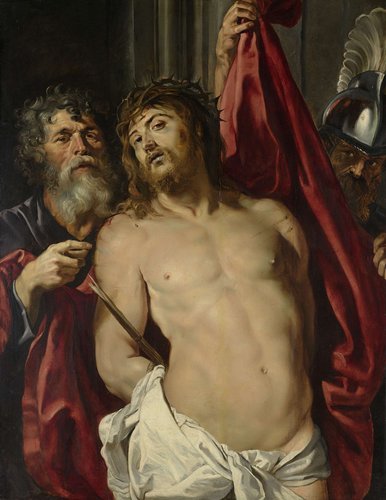
Ecce homo
1800 - 1857
Medium
oil on panel
Dimensions
125; 95
Rights
Public Domain
About this artwork
olieverf op paneel
Art Historical Context
Behold Peter Paul Rubens' *Ecce Homo*, a striking oil on panel painting (125 cm × 95 cm) that captures the biblical moment when Pontius Pilate presents the thorn-crowned Christ to the crowd, uttering "Behold the man!" Housed in the Rijksmuseum, this work reflects Rubens' mastery of the Baroque style, even as its dating to 1800–1857 suggests it may be a later attribution or workshop piece inspired by the Flemish master's dramatic flair. Rubens, a leading figure of the 17th-century Baroque, was renowned for his vibrant oils on panel—a medium that allowed for luminous colors, textured brushwork, and emotional intensity. Here, the intimate scale invites viewers close, emphasizing Christ's suffering expression and the interplay of light and shadow, hallmarks of Counter-Reformation art meant to evoke devotion and pathos. Culturally, *Ecce Homo* scenes were immensely popular in Northern Europe, blending religious narrative with humanism. This piece underscores Rubens' enduring influence on devotional art, bridging 17th-century dynamism with 19th-century appreciation in the Rijksmuseum's collection. A poignant reminder of faith's visual power.
About the Artist
Peter Paul Rubens · 1577–1640
Peter Paul Rubens (1577-1640) stands as the most influential artist of the Flemish Baroque tradition and the greatest exponent of Baroque painting's dynamism, vitality, and sensuous exuberance. Born in Siegen, Westphalia, and raised in Antwerp, Rubens received a humanist education studying Latin and classical literature before pursuing artistic training under three masters: Tobias Verhaecht, Adam ...