
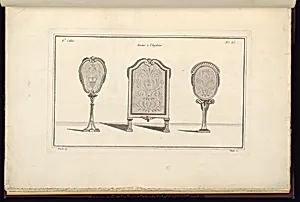
Ecrans à l'Angloise
Medium
Classification
Department
Smithsonian Collection
Museum
Smithsonian American Art Museum
Credit
Purchased for the Museum by the Advisory Council
Accession Number
1921-6-252-35
Rights
Public Domain
About this artwork
Research in Progress
Art Historical Context
Juste-François Boucher (1736–1782), son of the renowned Rococo master François Boucher, created *Ecrans à l'Angloise* around 1775. This elegant print captures the mid-18th-century French fascination with English design trends. As a skilled engraver, Boucher translated intricate decorative motifs into accessible prints, bridging fine art and everyday fashion. The title, meaning "Screens in the English Style," reflects the era's "Anglomania"—a cultural wave in pre-Revolutionary France where English furniture, textiles, and interiors inspired French elites. Fire screens (écrans) were essential parlor accessories, shielding faces from hearth flames while showcasing ornate patterns. Boucher's work likely illustrates these stylish objects, blending Rococo playfulness with emerging Neoclassical restraint. Housed in the Smithsonian American Art Museum's print collection, this piece highlights printmaking's role in spreading design ideas across Europe. Purchased by the Advisory Council, it invites us to appreciate how art democratized luxury, offering a window into 18th-century tastes amid social change. (178 words)