
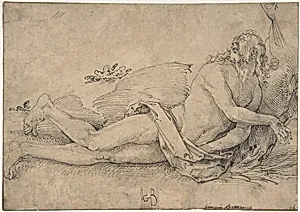
Ecstatic Christ
ca. 1510–11
Medium
Pen and two shades of carbon black ink, traces of black chalk underdrawing
Dimensions
6 11/16 x 9 7/16 in. (16.9 x 24.0 cm)
Classification
Drawings
Department
Robert Lehman Collection
Museum
Metropolitan Museum of Art, New York, NY
Credit
Robert Lehman Collection, 1975
Accession Number
1975.1.855
Rights
Public Domain
Tags
Art Historical Context
Created around 1510–11, Hans Baldung’s “Ecstatic Christ” reflects the intense religious feeling of the Northern Renaissance in. A pupil and close associate of Albrecht Dürer, Baldung often infused traditional Christian subjects with heightened emotion and expressive line, qualities that suited the turbulent spiritual climate just before the Reformation. Executed in pen and two shades of carbon black ink over faint black-chalk underdrawing, the small sheet (roughly 6 11/16 by 9 7/16 inches) demonstrates the artist’s command of tonal contrast and fluid contour. Such drawings served both as independent works and as studies, allowing Baldung to explore dramatic poses and spiritual intensity within a portable, intimate format. Now in the Metropolitan Museum’s Robert Lehman Collection, the drawing invites quiet contemplation of Christ’s ecstatic state, reminding visitors how Renaissance artists used economical means to convey profound faith and human vulnerability.
About the Artist
Hans Baldung (called Hans Baldung Grien) · 1484–1545
Hans Baldung Grien (1484/85–1545), born in Schwäbisch Gmünd into an erudite family of jurists and physicians, forsook academia to pursue art. His early training around 1500 took place in the Upper Rhineland, likely Strasbourg, before he apprenticed under Albrecht Dürer in Nuremberg from 1503 to 1507. There, the young artist honed his skills in painting, printmaking, and stained glass, even managin...