
Edö
1907
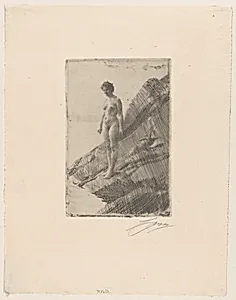
Medium
Etching; third state of three (Asplund)
Dimensions
Plate: 7 1/16 × 4 3/4 in. (17.9 × 12 cm) Sheet: 12 13/16 × 9 15/16 in. (32.6 × 25.2 cm)
Classification
Prints
Department
Drawings and Prints
Museum
Metropolitan Museum of Art, New York, NY
Credit
Harris Brisbane Dick Fund, 1917
Accession Number
17.3.713
Rights
Public Domain
Tags
Art Historical Context
Anders Zorn's *Edö* (1907) is a masterful etching from the Metropolitan Museum of Art's and Prints collection, showcasing the Swedish artist's prowess in capturing the human form. This intimate female nude, printed in the third and final state of three as catalogued by Asplund, measures 7 1/16 × 4 3/4 inches the plate. Acquired the Harris Brisbane Dick Fund in 1917, it exemplifies Zorn's late-career finesse in printmaking, where he blended impressionistic fluidity with precise line work. Zorn (1860–1920), a leading figure in Scandinavian and international art, was renowned for his etchings that rivaled paintings in luminosity and texture. Etching allowed him to explore subtle tonal gradations and the play of light on skin, techniques rooted in 19th-century European print traditions. The progressive states reveal his meticulous refinement process, with the third state offering the polished, definitive image— a testament to etching's appeal as both an intimate medium and a reproducible art form. *Edö* reflects early 20th-century fascination with naturalism and the female nude, inviting viewers to appreciate Zorn's technical virtuosity and sensual elegance. A gem for print enthusiasts, it highlights how etchings bridged fine art and accessibility in museum collections.
About the Artist
Anders Zorn · 1860–1920
Anders Zorn (1860–1920), one of Sweden's most celebrated artists, was born on February 18 in Utmeland near Mora in Dalarna, and raised on his maternal grandparents' farm in the nearby hamlet of Yvraden. Displaying prodigious talent from a young age, he attended school in Mora Strand until age twelve, followed by secondary grammar school in Enköping, where he excelled in drawing people and horses. ...