
Education
n.d.
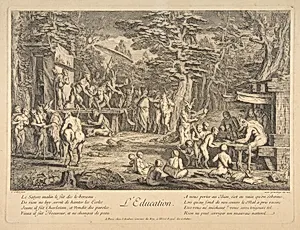
Medium
Etching, third state
Dimensions
sheet: 11 3/4 x 15 1/4 in. (29.9 x 38.8 cm) image: 9 13/16 x 13 1/8 in. (25 x 33.3 cm)
Classification
Prints
Department
Drawings and Prints
Museum
Metropolitan Museum of Art, New York, NY
Credit
The Elisha Whittelsey Collection, The Elisha Whittelsey Fund, 1960
Accession Number
60.611.20
Rights
Public Domain
Tags
Art Historical Context
Claude Gillot, a French artist active in the early eighteenth century, created this etching titled *Education* as part of his exploration of everyday and allegorical subjects. Working during the transition from the Baroque to the Rococo period, Gillot was known for his lively draftsmanship and often produced designs that captured theatrical, satirical, or instructional themes. The print, preserved here in its third state, reflects the period’s growing interest in moral and educational imagery intended for a broader audience. Executed in etching, a technique that allowed artists to achieve fine linear detail and tonal subtlety through acid biting on metal plates, the work exemplifies how prints served both artistic and didactic purposes. Etchings like this one could be produced in multiples, making scenes of learning and social instruction widely accessible beyond elite collectors. The dimensions and careful impression suggest it was valued as both a technical achievement and a cultural document. Now housed in the Metropolitan Museum of Art’s Department of Drawings and Prints as part of the Elisha Whittelsey Collection, *Education* offers visitors a glimpse into Enlightenment-era attitudes toward knowledge and upbringing. Its presence in the museum underscores the enduring role of prints in preserving and sharing ideas about education across centuries.
About the Artist
Claude Gillot · 1673–1722
Artist known for his elegant designs done in the Rococo manner of Audran; also for his predilection for scenes from the 'comedia dell'arte.' Few paintings survive; his work is known mainly through drawings and etchings. Comment on works: Genre; History