
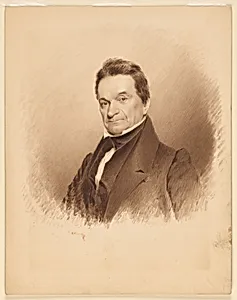
Edward Livingston
Medium
Drawing
Classification
Drawing
Department
Smithsonian Collection
Museum
Smithsonian American Art Museum
Credit
National Portrait Gallery, Smithsonian Institution
Accession Number
NPG.76.62
Rights
Public Domain
Tags
Art Historical Context
**Edward Livingston** is a compelling c. 1833 drawing James Barton Longacre (1794–1869), capturing the likeness of one of America's most versatile statesmen. Housed in the Smithsonian American Art Museum and credited to the National Portrait Gallery this portrait from the Smithsonian Collection showcases Longacre's skill in preparatory drawings, often used for his renowned engravings. Rendered in a precise, realistic style typical of early 19th American portraiture, it highlights Livingston's dignified features, reflecting the era's emphasis on character and intellect in visual representation. Edward Livingston (1764–1836) embodied the dynamic spirit of early American politics, serving as a lawyer, U.S. Attorney in Louisiana, Mayor of New York, U.S. Senator, Secretary of State under President Andrew Jackson (1831–1833), and Minister to France. Born in New York, he later thrived in Louisiana, navigating legal reforms amid the young nation's expansion. This drawing, timed to his tenure as Secretary of State, immortalizes a man who drafted influential penal codes and championed constitutional principles during pivotal moments like the War of 1812. As a rare surviving drawing by Longacre—a master engraver whose works graced currency and books—this piece offers insight into the technical foundations of portraiture. It invites visitors to ponder Livingston's enduring legacy in shaping U.S. law and diplomacy, bridging personal portraiture with national history.