
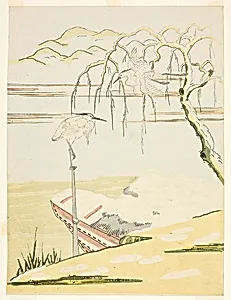
Egrets in the Snow
c. 1768
Medium
Color woodblock print; chuban
Dimensions
27.6 × 20.6 cm (10 7/8 × 8 1/8 in.)
Classification
woodblock print
Department
Arts of Asia
Museum
Art Institute of Chicago
Accession Number
23201
Rights
Public Domain
Art Historical Context
Suzuki Harunobu's *Egrets in the Snow* (c. 1768) is a delicate color woodblock print from Japan's Edo period, capturing the serene beauty of winter Harunobu, a master of ukiyo-e—the "pictures of the floating world" genre that celebrated ephemeral pleasures—pioneered full-color nishiki-e prints around 1765. This chuban-format work (27.6 × 20.6 cm), smaller and more intimate than larger oban prints, invites close contemplation of its minimalist composition: elegant egrets poised amid falling snowflakes and bare branches. The print showcases Harunobu's innovative techniques, layering vibrant hues through precise woodblock carving and multiple color applications, achieving subtle gradients and textures that evoke frost and mist. Belonging to the Arts of Asia collection at the Art Institute of Chicago, it reflects ukiyo-e's shift toward nature subjects alongside bijin-ga (images of beauties), blending poetic realism with haiku-like simplicity. Culturally, such prints were affordable art for urban dwellers, spreading seasonal motifs that symbolized purity and transience in Japanese aesthetics. *Egrets in the Snow* endures as a testament to Harunobu's influence on later masters like Hiroshige and Hokusai, offering visitors a window into 18th-century Japan's refined harmony with nature.
About the Artist
Suzuki Harunobu · 1725–1770
Suzuki Harunobu (c. 1725-1770) was a Japanese ukiyo-e artist who revolutionized woodblock printing by developing nishiki-e—full-color prints using multiple woodblocks—in 1765. Before Harunobu, Japanese prints were limited to two or three colors; his innovation unleashed the entire artist's palette, transforming ukiyo-e into the vibrant art form that would later captivate Western artists from Manet...