
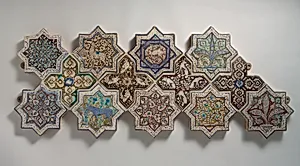
Eight-Pointed Star-Shaped Tile
Unknown Artist
13th century
Medium
Stonepaste; inglaze painted in blue, luster-painted on opaque white glaze
Dimensions
Diam. 6 7/8 in. (17.5 cm) Wt. (panel group) 31 lbs. (14.1 kg)
Classification
Ceramics-Tiles
Department
Islamic Art
Museum
Metropolitan Museum of Art, New York, NY
Credit
Edward C. Moore Collection, Bequest of Edward C. Moore, 1891
Accession Number
91.1.106
Rights
Public Domain
Tags
Art Historical Context
This exquisite eight-pointed star-shaped tile crafted in the 13th, exemplifies the pinnacle of Islamic ceramic artistry from the medieval Islamic world, likely Persia or Syria. Fashioned from stonepaste—a composite of quartz, clay, and glass frit—the tile measures 6 7/8 inches in diameter and an opaque white glaze adorned with intricate blue underglaze painting and shimmering luster accents. The eight-pointed star motif, a hallmark of Islamic geometric design, evokes cosmic harmony and infinite patterns, often symbolizing unity in the cosmos. The innovative techniques here highlight technological prowess: inglaze painting in cobalt blue ensured color vibrancy beneath the glaze, while lusterware—metallic oxides fired in a reducing atmosphere—created a golden iridescence rivaling precious metals. This labor-intensive process, perfected during the Seljuk and early Mongol periods, elevated tiles from mere building materials to architectural jewels, adorning mosque mihrabs, palace domes, and madrasas. Housed in the Metropolitan Museum of Art's Islamic Art Department as part of the Edward C. Moore Collection (1891), this tile invites visitors to marvel at how 13th-century artisans transformed humble clay into luminous splendor, bridging faith, mathematics, and beauty in enduring Islamic tradition.