
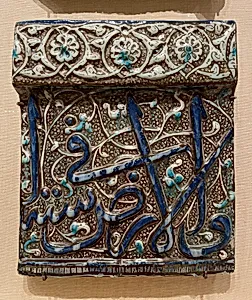
Tile from an Inscriptional Frieze
Unknown Artist
dated A.H. 734/1334 CE
Medium
Stonepaste; modeled, inglaze painted in blue, luster-painted on opaque white glaze
Dimensions
H. 17 5/8 in. (44.8 cm) W. 15 1/2 in. (39.4 cm) D. 2 5/8 in. (6.7 cm)
Classification
Ceramics-Tiles
Department
Islamic Art
Museum
Metropolitan Museum of Art, New York, NY
Credit
H.O. Havemeyer Collection, Gift of Horace Havemeyer, 1940
Accession Number
40.181.6
Rights
Public Domain
Art Historical Context
This exquisite tile, dated A.H. 734 (1334 CE), hails from the Islamic world during a golden age of architectural splendor, likely in Persia or a neighboring region renowned for monumental ceramics. As part of an inscriptionalieze, it once adorned a mosque, madrasa, or palace, a rhythmic band of calligraphy that conveyed sacred verses, poetry, or royal dedications. Such friezes elevated spaces with their elegant script, blending devotion and artistry in everyday worship and grandeur. Crafted from stonepaste—a durable, vitreous ceramic body perfected by Islamic potters for large-scale architectural use—the tile features sophisticated techniques: modeling for relief, underglaze painting in vibrant cobalt blue, and luster-painting over an opaque white glaze. Lusterware, with its shimmering metallic sheen, was a prized innovation, mimicking precious metals while resisting wear. Measuring about 18 by 15 inches, this substantial piece highlights the era's mastery of color, form, and permanence. Today, in the Metropolitan Museum of Art's Islamic Art Department (gift of the H.O. Havemeyer Collection, 1940), it invites us to marvel at medieval ingenuity—where a single tile captured eternity's glow.