
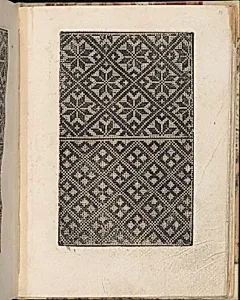
Ein new getruckt model Büchli...Page 10, verso
Medium
Woodcut
Dimensions
Overall: 7 7/8 x 6 1/8 in. (20 x 15.5 cm)
Classification
Books|Prints|Ornament & Architecture
Department
Drawings and Prints
Museum
Metropolitan Museum of Art, New York, NY
Credit
Rogers Fund, 1918
Accession Number
18.66.2(10v)
Rights
Public Domain
Tags
Art Historical Context
Step into the intricate world of Renaissance ornamentation with *Ein new getruckt modelchli...Page 10, verso* (1529), a woodcut print by Johann Schönsper the Younger, a prominent Augsburg printer and publisher. page from a "newly printed model booklet" showcases delicate architectural and decorative motifs, designed as a practical resource for artisans, goldsmiths, architects during the early 16th century. Measuring just 7 7/8 x 6 1/8 inches, its compact size made it an accessible pattern book for workshops across Europe. Schönsperger's work reflects the German Renaissance's fascination with symmetry, grotesques, and classical motifs inspired by Italian prints flooding northward. Model books like this were revolutionary, standardizing designs for everything from book illustrations to metalwork and textiles, democratizing artistic knowledge amid the printing revolution sparked by Gutenberg. Woodcut technique—carving images in relief on wooden blocks—ensured durability and crisp lines, ideal for mass production. Housed in the Metropolitan Museum of Art's Drawings and Prints department (Rogers Fund, 1918), this piece highlights how prints bridged fine art and craft, fueling the era's decorative explosion. Imagine craftsmen poring over it by candlelight, adapting its flourishes to cathedrals or jewelry—what creativity it sparked!
About the Artist
Johann Schönsperger the Younger · 1490–1550
Johann Schönsperger the Younger, born around 1480 in Augsburg, was the son of the prominent printer Johann Schönsperger the Elder, with whom he apprenticed in the family trade. As a member of the Salzfertiger guild, he entered publishing around 1502, initially focusing on illustrated edification literature, medical texts, weather prognostications, and works by Erasmus in Augsburg. A notable early ...