
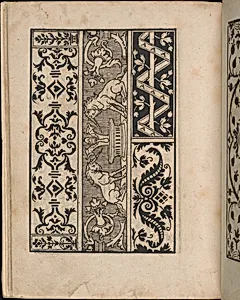
Ein new Modelbuch..., page 11 (verso)
October 22, 1524
Medium
Woodcut
Dimensions
7 5/16 x 5 3/8 in. (18.5 x 13.6 cm)
Classification
Books|Prints|Ornament & Architecture
Department
Drawings and Prints
Museum
Metropolitan Museum of Art, New York, NY
Credit
Gift of Herbert N. Straus, 1929
Accession Number
29.71(22)
Rights
Public Domain
Tags
Art Historical Context
This woodcut comes from *Ein new Modelbuch*, a pattern book published on October 22, 1524, by Johann Schönsperger the Younger in Augsburg. As a printer active during the early Renaissance, Schönsperger specialized in producing affordable illustrated volumes that circulated ornamental designs across Europe. The page, measuring just over seven by five inches, exemplifies the practical role of prints in spreading artistic motifs to artisans, needleworkers, and architects who could not access original drawings. The image features elaborate fountains entwined with unicorns, blending mythical imagery with functional decorative schemes typical of 16th-century ornament. Woodcut technique allowed these intricate patterns to be reproduced clearly and repeatedly, making complex Renaissance designs widely available. Such model books helped standardize visual vocabulary—classical fountains paired with symbolic creatures like unicorns—that appeared in textiles, metalwork, and garden architecture. Housed in the Metropolitan Museum of Art’s Department of Drawings and Prints, this sheet highlights how printed media democratized artistic ideas during the period. Its gift to the museum in 1929 by Herbert N. Straus underscores the enduring value of these modest yet influential pages in understanding early modern design culture.
About the Artist
Johann Schönsperger the Younger · 1490–1550
Johann Schönsperger the Younger, born around 1480 in Augsburg, was the son of the prominent printer Johann Schönsperger the Elder, with whom he apprenticed in the family trade. As a member of the Salzfertiger guild, he entered publishing around 1502, initially focusing on illustrated edification literature, medical texts, weather prognostications, and works by Erasmus in Augsburg. A notable early ...