
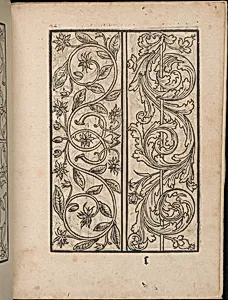
Ein new Modelbuch..., page 5 (recto)
October 22, 1524
Medium
Woodcut
Dimensions
7 5/16 x 5 3/8 in. (18.5 x 13.6 cm)
Classification
Books|Prints|Ornament & Architecture
Department
Drawings and Prints
Museum
Metropolitan Museum of Art, New York, NY
Credit
Gift of Herbert N. Straus, 1929
Accession Number
29.71(9)
Rights
Public Domain
Tags
Art Historical Context
Step into the intricate world of Renaissance design with *Ein new Modelbuch..., page5 (recto)*, a woodcut print by Schönsperger Younger, dated precisely to October 22, 1524. Produced in Augsburg, Germany, this modest page—measuring just 7 5/16 x 5 3/8 inches—forms part of a "model book," a practical guidebook filled with repeatable patterns for artisans. Schönsperger, a skilled printer and woodcutter, specialized such volumes, bridging the gap between Italian Renaissance grotesques and Northern European craftsmanship. The woodcut medium shines here, with its bold, carved lines capturing delicate acorn motifs amid ornamental flourishes. These designs, tagged simply as "Acorns," were essential tools for goldsmiths, embroiderers, and architects, offering scalable templates for jewelry, textiles, and decorative architecture. Woodcuts like this allowed affordable dissemination of motifs, democratizing high-style ornamentation during the early 16th century's artistic boom. Today, this gem resides in the Metropolitan Museum of Art's Drawings and Prints department, a gift from Herbert N. Straus in 1929. It whispers of a time when patterns fueled creativity across trades, reminding us how a single page could inspire endless beauty.
About the Artist
Johann Schönsperger the Younger · 1490–1550
Johann Schönsperger the Younger, born around 1480 in Augsburg, was the son of the prominent printer Johann Schönsperger the Elder, with whom he apprenticed in the family trade. As a member of the Salzfertiger guild, he entered publishing around 1502, initially focusing on illustrated edification literature, medical texts, weather prognostications, and works by Erasmus in Augsburg. A notable early ...