
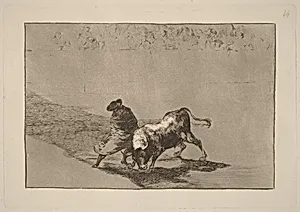
El diestrisimo estudiante de Falces, embozadoburla al toro con sus quiebros (The Very Skillful Student of Falces, Wrapped in His Cape, Tricks the Bull with the Play of His Body)
in or before 1816
Medium
etching, aquatint, drypoint and burin [first edition impression]
Classification
Portfolio
Department
CG-E
Museum
National Gallery of Art, Washington, D.C.
Credit
Rosenwald Collection
Accession Number
1943.3.1633
Rights
Public Domain
Art Historical Context
Francisco Goya's *El diestrisimo de Falces, embozadoburla al toro con sus quieb* (The Very Skillful Student of Falces, Wrapped in Cape, Tricks the Bull the Play of His Body), created in or before 1816, captures the raw drama of Spanish bullfighting. Part of Goya's renowned *Tauromaquia* series—a portfolio of 33 prints from the artist's later years—this etching celebrates the courage and artistry of the bullfighter, here a deft student from Falces who evades the charging bull with graceful cape work and agile body movements. Produced amid Spain's turbulent Napoleonic era and the restoration of Ferdinand VII, Goya's works reflect national pride in bullfighting as a cultural ritual blending danger, skill, and spectacle. Goya, a master of Romanticism, employed advanced printmaking techniques: etching for precise lines, aquatint for moody tonal depths, drypoint for expressive burrs, and burin for refined detailing. This first-edition impression from the National Gallery of Art's Rosenwald Collection preserves the vivid contrasts and dynamic energy that make his prints so immersive, evoking the dust, sweat, and tension of the arena. These prints not only showcase Goya's technical brilliance but also immortalize bullfighting's folklore, transforming brutal tradition into high art. Visitors will appreciate how Goya elevates everyday heroism, inviting us to marvel at human defiance in the face of primal fury.
About the Artist
Francisco Goya · 1746–1828
Francisco Goya, born on March 30, 1746, in the small Aragonese village of Fuendetodos, Spain, to a gilder father and a mother from a family claiming minor nobility, displayed artistic promise early. At age 14, he apprenticed under painter José Luzán y Martínez in Zaragoza, honing his skills by copying prints before working independently. After unsuccessful attempts to enter Madrid's Real Academia ...