
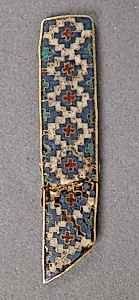
Element of a Border for an Icon Frame
Unknown Artist
10th century
Medium
Cloisonné enamel, gold
Dimensions
Overall: 5/16 x 1 9/16 x 1/16 in. (0.8 x 4 x 0.2 cm)
Classification
Enamels-Cloisonné
Culture
Byzantine
Department
Medieval Art
Museum
Metropolitan Museum of Art, New York, NY
Credit
Gift of J. Pierpont Morgan, 1917
Accession Number
17.190.654
Rights
Public Domain
Art Historical Context
This delicate *Element of a Border for Icon Frame*, crafted in the 10th century by an unknown Byzantine artist, offers a glimpse into the opulent world of medieval Orthodox Christianity. Measuring just 5/16 x 1 9/16 x 1/16 inches, this tiny gold piece was part of a larger frame encasing a sacred icon—paintings of Christ, the Virgin Mary, or saints revered as windows to the divine. In the Byzantine Empire, such frames elevated icons from mere images to holy treasures, adorning churches and monasteries across Constantinople and beyond. The artwork's medium, cloisonné enamel on gold, exemplifies Byzantine technical brilliance. Artisans soldered thin gold wires into cells (cloisons) on a gold base, filling them with finely ground glass pigments in vivid hues, then firing the piece to fuse the colors permanently. This labor-intensive process yielded jewel-like durability and luminescence, rivaling contemporary gems and symbolizing heavenly splendor. Its intricate design likely featured floral or geometric motifs, common in Byzantine borders, blending artistic refinement with spiritual symbolism. A gift to the Metropolitan Museum of Art from J. Pierpont Morgan in 1917, this fragment survives as a testament to Byzantium's enduring legacy in medieval art. Though small, it whispers of grand altarpieces that inspired awe, inviting us to marvel at the devotion behind each microscopic detail.