
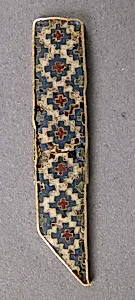
Element of a Border for an Icon Frame
Unknown Artist
10th century
Medium
Cloisonné enamel, gold
Dimensions
Overall: 1/4 x 1 7/16 x 1/16 in. (0.7 x 3.7 x 0.2 cm)
Classification
Enamels-Cloisonné
Culture
Byzantine
Department
Medieval Art
Museum
Metropolitan Museum of Art, New York, NY
Credit
Gift of J. Pierpont Morgan, 1917
Accession Number
17.190.656
Rights
Public Domain
Art Historical Context
This delicate *Element of a Border for Icon Frame*, crafted in the 10th century by an unknown Byzantine artist, exemplifies exquisite metalwork of the Medieval Byzantine world. Measuring just a quarter-inch high and under two inches long, this tiny gold piece was part of a larger ornate frame surrounding a religious icon—sacred images of Christ, the Virgin Mary, or saints that were venerated in Byzantine churches and homes. During the 10th century, the Empire flourished as a cultural bridge between East and West, blending Christian devotion with imperial splendor. The artwork's medium, cloisonné enamel on gold, highlights masterful technical innovation. Artisans soldered thin gold wires into cells (cloisons) on a gold base, filling them with finely ground glass enamels in vibrant colors, then firing the piece to fuse the materials. This labor-intensive process created durable, jewel-like surfaces resistant to wear, ideal for liturgical objects. Byzantine enamels, prized for their luminosity and precision, influenced European and Islamic art traditions. Today, this fragment at the Metropolitan Museum of Art—generously gifted by J. Pierpont Morgan in 1917—offers a glimpse into Byzantium's artistic piety, where even the smallest decorative element radiated divine glory.