
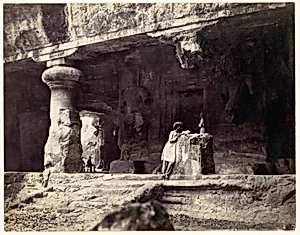
Elephanta from Water Cave, Coombe Martin Bay, Watermouth
1870s
Medium
Albumen silver print from glass negative
Classification
Photographs
Department
Photographs
Museum
Metropolitan Museum of Art, New York, NY
Credit
The Elisha Whittelsey Collection, The Elisha Whittelsey Fund, 1973
Accession Number
1973.502.1
Rights
Public Domain
Tags
Art Historical Context
In the serene coastal landscape of Coombe Martin Bay near Watermouth, Devon, England, Francis Frith's *Elephanta from Water Cave* (1870s) captures a dramatic vignette of natural wonder and human presence. The albumen silver print from a glass negative reveals the iconic Elephanta rock formation—a rugged outcrop resembling an elephant—viewed from the shadowy depths of a nearby cave. Figures of men, likely local explorers or fishermen, add a human scale, evoking Victorian-era fascination with Britain's wild shores and ancient sea-carved geology. Frith, a pioneering British photographer celebrated for his expansive travelogues of Egypt and the Holy Land, turned his lens to his homeland in the 1870s, documenting picturesque ruins and coastal scenes with meticulous clarity. The albumen process, dominant in the era, produced prints with warm tones and fine detail, preserving the interplay of light filtering into the cave and highlighting weathered rocks. This photograph exemplifies 19th-century topographical photography, blending scientific precision with romantic allure. Housed in The Metropolitan Museum of Art's Elisha Whittelsey Collection, the image reflects cultural shifts toward leisure travel and heritage preservation, inviting viewers to ponder the timeless dialogue between humanity and untamed nature. A window into Frith's versatile oeuvre, it reminds us how photography immortalized Britain's hidden gems for generations.
About the Artist
Francis Frith · 1822–1898
Francis Frith (1822–1898) was born on 7 October 1822 in Chesterfield, Derbyshire, into a prosperous Quaker merchant family as the second child and only son of Francis Frith Sr. and Alice Walker. Educated at Quaker schools including Ackworth and Camp Hill in Birmingham from around 1828 to 1838, he apprenticed in the cutlery trade before establishing himself as a wholesale grocer in Liverpool, suppl...