
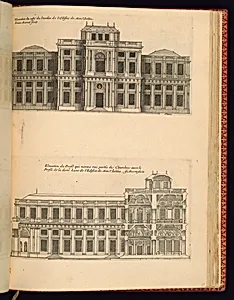
Elevation de costé du Jardin de l’Edifice de Monsr. Jabba (Upper Plate) / Elevation du Profil qui montre une partie des Chambres avec le Profil de la demi Lune de l’Edifice de Monsr. Jabba. (Lower Plate)
ca.1635–ca.1660
Classification
Department
Smithsonian Collection
Museum
Smithsonian American Art Museum
Credit
Purchased for the Museum by the Advisory Council
Accession Number
1921-6-351-53
Rights
Public Domain
About this artwork
Research in Progress
Art Historical Context
Jean Marot (1619–1679), a pioneering French engraver, captured the grandeur of 17th-century architecture in this intricate print, titled *Elevation de costé du de l'Edifice de Monsr. Jabba* (upper plate) and *Elevation Profil qui montre une partie Chambres avec le Profil la demi Lune* ( plate). Created around 1635–1660, it presents precise side elevations of a private residence belonging to Monsieur Jabba, showcasing its garden facade, interior chambers, and a distinctive half-moon feature. As a master of architectural documentation, Marot's work reflects the Baroque era's emphasis on symmetry, ornamentation, and harmonious proportions, bridging the late Renaissance and emerging classical French styles. Marot's prints, often etched with meticulous line work, served as vital records of aristocratic estates during Louis XIII's reign, preserving designs that might otherwise be lost to time. This piece belongs to his renowned suites of engravings, which influenced architects across Europe by disseminating innovative garden layouts and building profiles. Housed in the Smithsonian American Art Museum's collection—purchased by the Advisory Council—it highlights the era's fusion of art and engineering, inviting viewers to envision opulent private worlds. Though research continues, this print offers a window into France's architectural golden age, where every line tells a story of status, innovation, and aesthetic ambition.