
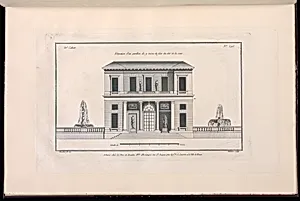
Elevation d'un pavillon de 9 toises de face du côté de la cour
Medium
Classification
Department
Smithsonian Collection
Museum
Smithsonian American Art Museum
Credit
Purchased for the Museum by the Advisory Council
Accession Number
1921-6-255-7
Rights
Public Domain
About this artwork
Research in Progress
Art Historical Context
Juste-François Boucher (6–1782), son of the renowned Rococo painter François Boucher, a skilled French architect and engraver whose work bridged the opulent Rococo style with emerging Neoclassical precision. Created around 1775, *Elevation d'un pavillon 9 toises de du côté de la cour ("Elevation of a Pavilion 9 Toises Wide on the Courtyard Side") exemplifies his expertise in architectural drafting. This detailed print depicts the frontal elevation of a elegant pavilion—likely a garden or estate structure—measuring about 18 meters across, viewed from the courtyard, capturing the symmetry and grandeur typical of late 18th-century French design. As a print medium, the work highlights Boucher's mastery of engraving techniques, allowing precise lines and subtle shading to convey architectural depth and proportion on paper. Produced during the transitional era before the French Revolution, it reflects the refined tastes of the aristocracy, where pavilions served as luxurious retreats amid formal gardens. Though research is ongoing, its presence in the Smithsonian American Art Museum's collection underscores the transatlantic influence of French architecture on early American neoclassicism. Purchased for the museum by the Advisory Council, this piece invites visitors to appreciate how printed designs democratized elite architectural ideas, inspiring builders worldwide. A window into Enlightenment-era elegance! (198 words)