
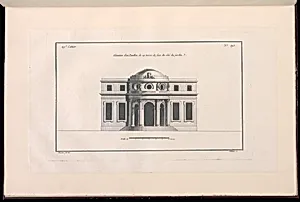
Elevation d'un Pavillon de 14 toises de face du còté du jardin
Classification
Department
Smithsonian Collection
Museum
Smithsonian American Art Museum
Credit
Purchased for the Museum by the Advisory Council
Accession Number
1921-6-255-5
Rights
Public Domain
About this artwork
Research in Progress
Art Historical Context
Juste-François Boucher (6–1782), son of the renowned Rococo painter François Boucher, created *Elevation d'un Pavillon 14 toises de du côté du jardin* 1775. This architectural print depicts the elegant garden-side elevation of a pavilion measuring 14 toises (roughly 90 feet) across, showcasing the refined proportions and decorative details typical of late 18th-century French design. As a member of a celebrated artistic dynasty, Boucher blended ornamental flair with functional architecture, reflecting the era's fascination with pleasure gardens and grand estates. Printed during the twilight of the Ancien Régime, the work captures the opulent yet poised aesthetic bridging Rococo exuberance and emerging Neoclassicism. Such elevations served as precise blueprints for builders and patrons, highlighting Boucher's skill in translating three-dimensional visions onto paper. Though the exact print medium remains unidentified, its classification underscores the technical precision of engraving or etching, vital for disseminating architectural ideas across Europe. Acquired by the Smithsonian American Art Museum through its Advisory Council, this piece invites reflection on transatlantic influences—French elegance shaping global tastes. Ongoing research promises deeper insights into its commission and legacy, making it a gem for enthusiasts of architectural history.