
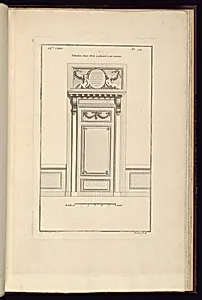
Elevation d'une Porte à placard à un vanteau
Classification
Department
Smithsonian Collection
Museum
Smithsonian American Art Museum
Credit
Purchased for the Museum by the Advisory Council
Accession Number
1921-6-253-48
Rights
Public Domain
About this artwork
Research in Progress
Art Historical Context
Juste-François Boucher (1736–1782), son of the renowned Rococo master François Boucher, was a skilled French engraver known for translating elaborate designs into precise prints. Created around 1775, *Elevation d'une Porte à placard à un vanteau*—or "Elevation of a Single-Door Wardrobe"—exemplifies the late 18th-century French tradition of architectural and decorative drafting. As a print, it likely served as a model for cabinetmakers, capturing the elegant proportions and ornate details of period furniture in a reproducible format. This work emerges during France's stylistic shift from opulent Rococo toward the refined Neoclassicism of Louis XVI's reign, blending symmetry with subtle embellishment. Such elevations were essential tools in the booming trade of luxury furnishings, disseminating high-style designs from royal workshops to elite homes across Europe. Housed in the Smithsonian American Art Museum's collection, purchased by the Advisory Council, this piece highlights transatlantic exchanges in design influences. Though research continues, it invites visitors to appreciate the meticulous craft of engraving and its role in shaping everyday elegance.