
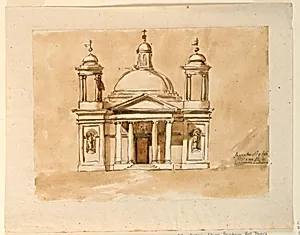
Elevation of a church
Classification
architecture
Department
Smithsonian Collection
Museum
Smithsonian American Art Museum
Credit
Museum purchase through gift of various donors and from Eleanor G. Hewitt Fund
Accession Number
1938-88-1202
Rights
Public Domain
About this artwork
Research in Progress
Art Historical Context
Giuseppe Barberi (1746–1809), a noted Italian architect, created *Elevation of a Church* 1777, offering a glimpse into 18th-century European design practices. This architectural drawing captures the facade of a grand ecclesiastical structure, a common format for envisioning sacred spaces during an era when church commissions reflected both spiritual devotion and advancing neoclassical ideals in Italy. An "elevation" like this one is a precise, two-dimensional rendering essential for architects to communicate scale, proportions, and decorative elements to builders and patrons. Barberi's work exemplifies the meticulous planning required for monumental buildings, blending symmetry and ornamentation in a style that bridged Baroque exuberance with emerging restraint. Though the medium remains unidentified amid ongoing research, such pieces were typically executed in ink, wash, or gouache on paper for clarity and portability. Acquired through museum purchase with gifts from various donors and the Eleanor G. Hewitt Fund, this piece enriches the Smithsonian American Art Museum's architecture collection. It invites visitors to appreciate how Italian ingenuity influenced global design traditions, even as research continues to uncover more about Barberi's process and patrons.