
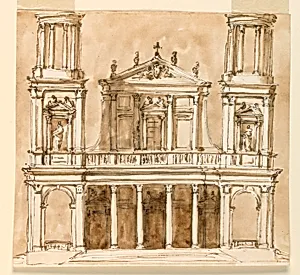
Elevation of a church
1746-1809
Medium
architecture
Classification
architecture
Department
Smithsonian Collection
Museum
Smithsonian American Art Museum
Credit
Museum purchase through gift of various donors and from Eleanor G. Hewitt Fund
Accession Number
1938-88-1217
Rights
Public Domain
About this artwork
Research in Progress
Art Historical Context
**Elevation of a Church** by Giuseppe Barberi (, 1746–1809) is a captivating architectural drawing from the Smithsonian American Art's collection. As an "elevation," it presents a precise, two-dimensional side view of a church facade, a fundamental technique in 18th-century architecture for planning and visualization. Barberi, a Roman architect and engraver active during the Enlightenment, contributed to Italy's rich tradition of ecclesiastical design, where such renderings bridged conceptual sketches and built structures. Created sometime between 1746 and 1809, this work exemplifies the meticulous draftsmanship of the period, likely employing ink, pencil, or wash on paper to convey proportions, ornamentation, and spatial harmony. Elevations like this were essential tools for architects collaborating with patrons, clergy, and builders, reflecting the era's emphasis on symmetry and grandeur in sacred spaces amid Italy's Baroque-to-Neoclassical transition. Acquired through museum purchase with gifts from various donors and the Eleanor G. Hewitt Fund, it resides in the Smithsonian Collection under the architecture classification. With research ongoing, this piece invites visitors to ponder Barberi's vision for worship and community, highlighting how drawings preserve unrealized dreams of faith and artistry. (198 words)