
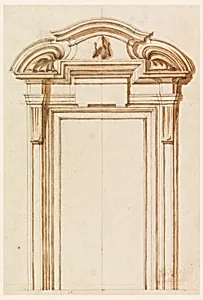
Elevation of a Door Case
Classification
architecture
Department
Smithsonian Collection
Museum
Smithsonian American Art Museum
Credit
Museum purchase through gift of various donors
Accession Number
1901-39-620
Rights
Public Domain
About this artwork
Research in Progress
Art Historical Context
Filippo Marchionni (1732–1805), a prominent Italian architect of the late Baroque and early Neoclassical periods, created *Elevation of a Door Case* between 1750 and 1775. This architectural drawing presents a precise frontal view—or "elevation"—of an ornate door surround, a key element in grand interiors of the era. Marchionni, known for his work in Rome on palaces and villas blending elegant symmetry with classical motifs, likely designed this as part of larger decorative schemes for ecclesiastical or aristocratic spaces. In the mid-18th century, Italian architecture was evolving from opulent Rococo flourishes toward the restrained grandeur of Neoclassicism, inspired by ancient Roman precedents. Such elevations served as blueprints for craftsmen, capturing intricate details like pediments, pilasters, and sculptural embellishments that conveyed status and harmony. Though the medium remains unidentified—possibly pen and ink, wash, or etching—this piece exemplifies the technical precision of architectural drafting, bridging design and execution. Housed in the Smithsonian American Art Museum's architecture collection through generous donor gifts, *Elevation of a Door Case* invites us to appreciate the artistry behind everyday opulence. Ongoing research promises deeper insights into its patronage and context, highlighting Marchionni's enduring influence on European design traditions.