
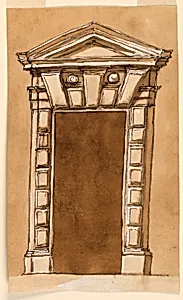
Elevation of a Door Frame
1780-1795
Classification
architecture
Department
Smithsonian Collection
Museum
Smithsonian American Art Museum
Credit
Museum purchase through gift of various donors and from Eleanor G. Hewitt Fund
Accession Number
1938-88-1086
Rights
Public Domain
About this artwork
Research in Progress
Art Historical Context
**Elevation of a Door Frame by Giuseppe Barberi (, 1746–1809) is a captivating architectural drawing from the late18th century, created between 1780 and1795. As an "elevation," it presents a precise frontal view of an ornate door frame, showcasing Barberi's expertise in decorative design. Housed in the Smithsonian American Art Museum's Collection, this work was acquired through museum purchase with gifts from various donors and Eleanor G. Hewitt Fund highlighting its value to architectural history. Barberi, a prominent Roman architect and ornamentalist during the Neoclassical era, specialized in elegant, symmetrical motifs inspired by ancient Roman antiquity. This piece reflects the period's revival of classical forms, blending functionality with refined decoration—think pilasters, entablatures, and subtle sculptural details that would grace grand palaces or public buildings. Though the medium remains unidentified amid ongoing research, such elevations were essential tools for architects, allowing builders to visualize and execute intricate facades with accuracy. For visitors, this drawing offers a window into 18th-century Italy's architectural renaissance, where Barberi's designs influenced interiors across Europe. Its presence in an American collection underscores the global reach of Neoclassical ideals, inviting us to appreciate the harmony of proportion and beauty in everyday elements like a simple door. (198 words)