
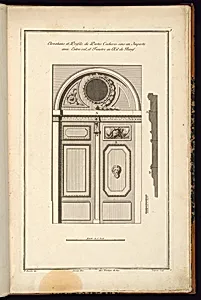
Elevations et Profils de Portes Cocheres sous un Imposte avec Entre-sol, et Fenetre en Oeil de Boeuf
Medium
Classification
Department
Smithsonian Collection
Museum
Smithsonian American Art Museum
Credit
Purchased for the Museum by the Advisory Council
Accession Number
1921-6-256-34
Rights
Public Domain
About this artwork
Research in Progress
Art Historical Context
Juste-François Boucher (1736–1782), son of the renowned Rococo François Boucher, created this intricate architectural print in 1774. Titled *Elevations et Profils Portes Cocheres un Imposte avec Entre, et Fenetre enil de Boeuf*, it showcases detailed elevations and profiles of coach doors (portes cochères) framed under an impost arch, complete with an entresolanine and a classic oeil-de-buf (bull's-eye) window. As a French engraver, Boucher captured the elegance of late 18th-century Parisian design, blending ornamental flair with functional precision. This print exemplifies the era's fascination with architectural dissemination through prints, a vital medium for sharing innovative designs among builders, architects, and nobility. Produced during the transition from Rococo exuberance to emerging Neoclassicism under Louis XVI, it reflects the sophisticated urban estates where horse-drawn carriages entered via these ornate portals. Boucher's fine line work highlights structural details, making it both a practical blueprint and an artistic study in symmetry and decoration. Acquired by the Smithsonian American Art Museum through its Advisory Council, this work invites visitors to appreciate how prints bridged art and architecture, preserving ephemeral designs for posterity. Though research continues, it stands as a window into Enlightenment-era opulence.