
Elongated Buckle
Unknown Artist
7th century (?)
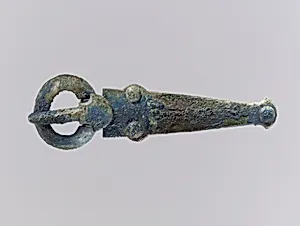
Medium
Copper alloy
Dimensions
Overall: 4 3/8 x 1 5/16 x 1/2 in. (11.1 x 3.3 x 1.2 cm)
Classification
Metalwork-Copper alloy
Culture
Langobardic or Frankish
Department
Medieval Art
Museum
Metropolitan Museum of Art, New York, NY
Credit
Gift of J. Pierpont Morgan, 1917
Accession Number
17.193.167
Rights
Public Domain
Art Historical Context
This elongated buckle, crafted from copper alloy in the 7th century (?), exemplifies the skilled metalwork of either Langobardic or Frankish cultures during the early Middle Ages. Measuring just 4 3/8 x 1 5/16 x 1/2 inches, its slender, functional form was likely designed for a belt, a common accessory that signified status and identity among early medieval elites. The Lombards, who ruled much of Italy after their 6th-century invasions, and the Franks, dominant in what is now France and Germany, both produced such finely wrought personal ornaments, often found in burials as grave goods. Copper alloy was a practical yet versatile medium for these artisans, allowing for casting and possible decoration techniques that balanced durability with aesthetic appeal. Buckles like this one highlight the transition from late antiquity to the medieval world, where everyday objects blended utilitarian purpose with subtle artistry, reflecting cultural exchanges across Europe. A generous gift from J. Pierpont Morgan in 1917, this piece now resides in the Metropolitan Museum of Art's Medieval Art department, offering visitors a tangible link to the vibrant, migratory societies of 7th-century Europe.